


Feb 8, 2026 1-2pm ET
Sunday on The Robert Scott Bell Show:

 This Sunday Conversation steps directly into a topic most Americans spend their lives avoiding: dying. Super Don and I do not approach it as a macabre subject, but as an unavoidable and deeply human reality that reveals how profoundly modern medicine has reshaped not just how we live, but how we die. We explore the journey of the soul, the fear embedded in American culture around death, and the extent to which pharmaceutical and hospital-based interventions have replaced dignity, presence, and peace at the end of life.
I share personal experiences that shape this perspective, from witnessing my grandfather and father die surrounded by machines and tubes, to seeing the stark contrast in my mother’s life at 92 – active, medication-free, riding an exercise bike during our conversation. These lived examples raise uncomfortable but necessary questions about patterns, epigenetics, and whether the way we live determines not just longevity, but the quality of our final chapter.
 The discussion turns to Scott Adams and his very public journey with terminal cancer, which forces a national reckoning with what medicalized death looks like in real time. Despite wealth, elite doctors, experimental treatments, and political access, Adams’ experience exposes the limits of high-tech medicine when prevention, nutrition, minerals, and terrain are ignored. We ask the hard question: are we extending life, or are we extending dying?
Super Don grounds the conversation in reality, emphasizing consent, autonomy, and the cultural default toward aggressive intervention even when it no longer serves the patient. We discuss how hospitals and pharmaceutical systems are designed to act, not pause, and how families are often made to feel that choosing comfort, hospice, or dignity is equivalent to giving up. The system refills prescriptions, bills insurance, and keeps going unless someone actively stops it.
 We connect the medicalization of death to the medicalization of life itself. A toxic food supply, chemical exposure, nutrient depletion, and lifelong pharmaceutical dependence create the very chronic diseases that later justify extreme end-of-life interventions. We contrast this with blue zones and ancestral cultures where death is accepted as natural, not fought as a technical failure, and where people often pass peacefully without prolonged suffering.
As the conversation closes, the message is not about rejecting medicine outright, nor about denying death. It is about reclaiming agency, informed consent, and the freedom to choose how we live and how we die. We are not promised immortality, but we are offered responsibility. Responsibility to nourish the body, respect natural law, and live consciously so that death, when it comes, is not something we fear or outsource entirely to machines. The power to heal is yours – and so is the power to choose the path you walk to the very end.
 What Scott Adams’ Bold Prediction & Final Chapter Teaches Us About Medicalized Death Scott Adams’ confrontation with terminal illness becomes a lens for examining how modern medicine and culture approach death as something to be postponed, managed, or denied rather than understood and accepted. Facing his own mortality, Adams speaks openly about the failures of a system that prioritizes intervention over dignity, often prolonging suffering while stripping patients of agency. His reflections challenge the belief that more treatment always equals better care, emphasizing instead the importance of informed consent, honest prognosis, and personal choice at the end of life. The piece underscores how medicalized death can obscure meaningful preparation, emotional closure, and autonomy, replacing them with false hope and institutional momentum. Adams’ final chapter is presented as a rare moment of clarity, where the incentive to conform disappears and truth takes precedence over reassurance. His experience serves as a warning about the costs of avoiding hard conversations and a call to reclaim ownership over how life ends, not just how long it lasts.
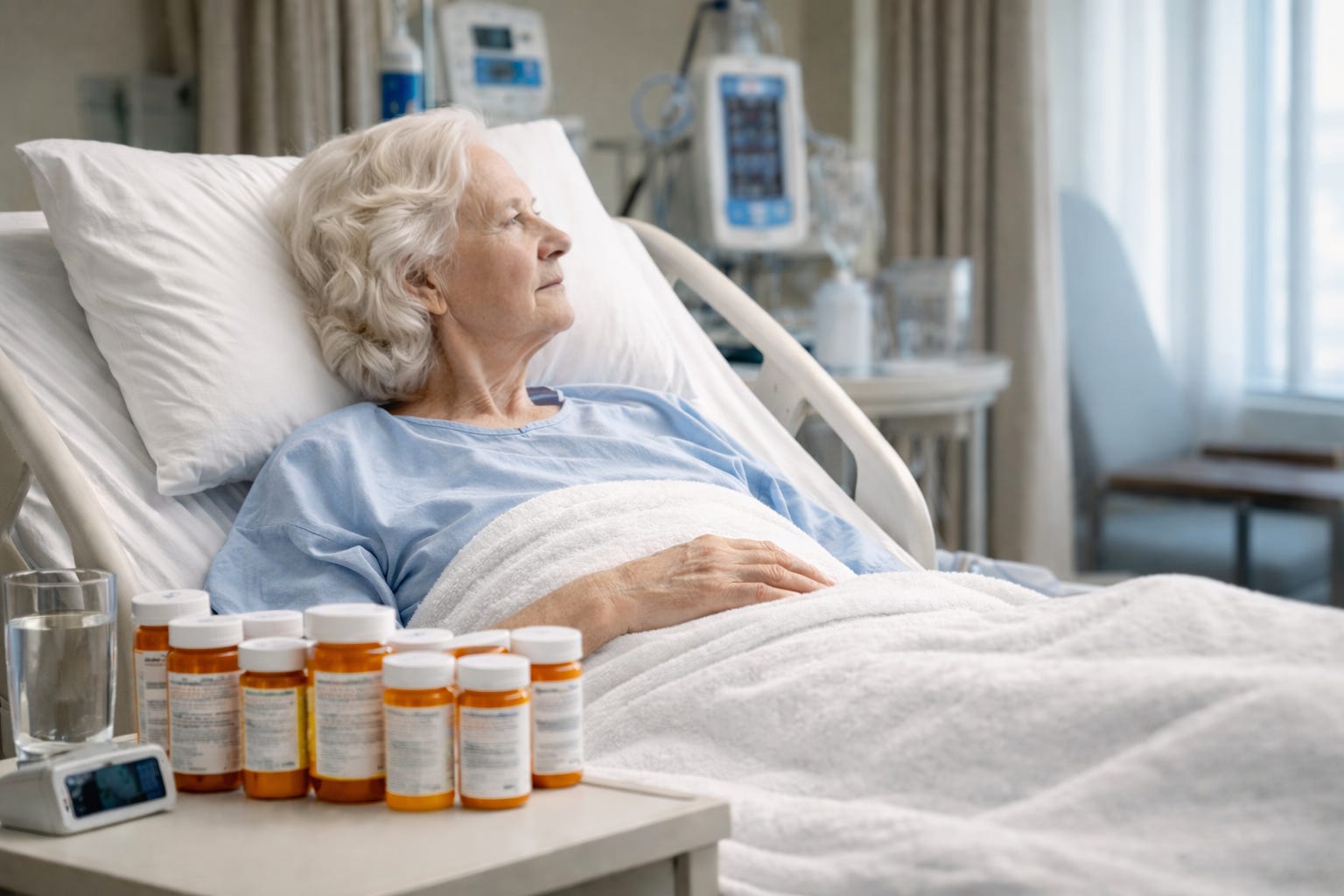 Grandma Is Dying, But The Refills Aren’t Sitting across from an elderly relative dying of cancer forces a hard question that modern medicine rarely wants to answer: if death is certain, why do the prescriptions keep coming? Drawing on a Medical Xpress report summarizing a University of Tsukuba study, the piece walks through data showing that more than 70 percent of elderly cancer patients remain on at least one potentially inappropriate medication even in the final month of life. These are not marginal cases but people with advanced cancer and limited time, still swallowing preventive and chronic-disease drugs that require years to show benefit. The pattern is not isolated to Japan but mirrors findings across Europe and aligns with what likely happens in the United States, where hundreds of thousands of older cancer patients may die each year while still taking medications that offer little benefit and real burden. Layered onto this is decades of documented pharmaceutical fraud, industry payments to physicians that correlate with increased prescribing, and a healthcare culture built to start drugs, not stop them. No conspiracy is required – the incentives, habits, and financial structures quietly keep refills flowing, even when comfort, dignity, and peace should clearly take precedence over one more pill.
Remember Friends, The Power to Heal is Yours!
