

Sep 11, 2026 3-5pm ET
Friday on The Robert Scott Bell Show:

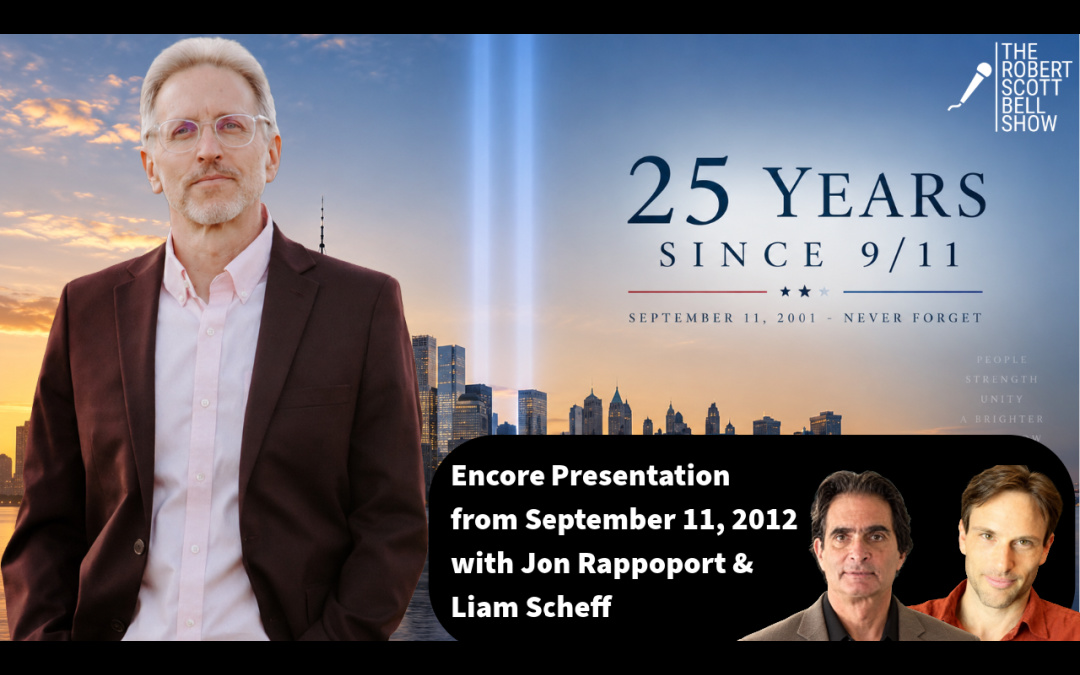
 On September 11, 2012, eleven years after the attacks that changed America and much of the world, we opened The Robert Scott Bell Show with a very different kind of remembrance. We acknowledged the lives lost, the families who continued to grieve, and the emotional weight that September 11 still carried. But we also asked the questions that were increasingly absent from the official commemorations. What actually happened? Why did it happen? What did Americans surrender in the aftermath? And what happens to a free people when fear becomes the justification for surveillance, war, centralized power and the steady erosion of individual liberty?
For that conversation, I welcomed my dear friend Jon Rappoport of No More Fake News. Jon was never interested in simply accepting an official story because government authorities, intelligence agencies or major media outlets told us it was true. By 2012, he argued that the official account of 9/11 had been challenged from countless directions, but our conversation went beyond debating the events of that single day. Jon wanted to examine what followed and, more importantly, what those consequences revealed about the direction in which society was already moving.
Jon’s central argument was that the surveillance state did not suddenly spring into existence because of September 11. He described surveillance technology, electronic tracking, cameras, cell-phone monitoring, smart meters and other systems of observation as developments that had already been moving forward. In his view, 9/11 became the massive psychological and political justification for accelerating them. The promise was security – we must watch more, track more and know more in order to prevent another attack. Jon warned that surveillance itself was only the first step. Once you have the ability to track a population, the next temptation is to control that population.
That brought us to the words that kept resurfacing throughout our discussion: captive and control. Jon described a technocratic worldview in which human beings are reduced to numbers, data points and pieces on a chessboard. Food, water, energy, transportation and even the ability to move freely could ultimately be administered from above in the name of efficiency, scarcity, safety or the “greatest good for the greatest number.” And that phrase became one of the most important parts of our conversation. Who decides what the greatest good is? Who gets to determine what must be sacrificed to achieve it? And what happens when the individual becomes expendable in pursuit of some supposedly benevolent collective goal?
 Jon explained how propaganda works by selling people an attractive general principle while keeping them from examining the details of how that principle will actually be implemented. Tell people that something is compassionate, humanitarian, necessary for safety or beneficial to everyone, and many will accept the premise before asking what powers they are surrendering. Once the principle is accepted, the details are left to politicians, bureaucrats, technocrats and institutions. That is where, Jon argued, a seemingly noble idea can become the justification for extraordinary control.
From there, we went directly to the foundation that Jon believed had been forgotten – individual freedom. We talked about Thomas Jefferson, the American experiment and the revolutionary idea that an individual does not belong to a king, a government or a collective. Jon argued that generations of Americans had gradually developed what he called an “amnesia” about individual liberty. People had been conditioned to think primarily in terms of the group, the collective, the social contract and the idea that “we’re all in this together,” without stopping to ask who defines the contract, who enforces it and whether the individual ever actually consented to it.
That discussion moved naturally into something listeners of this show know very well: health freedom. We connected the same battle over individual sovereignty to medicine, Obamacare, the history of organized medicine and the growing tendency to portray people who question established systems as irresponsible, dangerous or even mentally defective. Whether the issue is medical choice, food, energy, surveillance or political power, the underlying question remains the same: Who owns your life? Who gets to decide what you may put into your body, how you may live, what you may question and what choices you are permitted to make?
Listening to Jon again today carries an additional weight because he is no longer here with us. But what makes conversations like this worth preserving is that they were never merely about the headlines of one particular year. Jon was asking timeless questions about propaganda, fear, centralized power, conformity and the sovereignty of the individual. Eleven years after 9/11, we were asking what America had learned from that day and whether fear had been used to move the country toward something fundamentally incompatible with liberty.
Fourteen years after this conversation originally aired, we return to it as a special encore. Listen not simply as a historical artifact from September 11, 2012, but as a conversation about what happens when people surrender their responsibility to question authority. Jon Rappoport challenged us to look beyond the generalities, examine the details and remember that freedom ultimately begins with the individual.
The power to heal – and the responsibility to remain free – is still yours.

 In hour two of our September 11, 2012 broadcast, I was joined by my dear friend, frequent co-host and occasional substitute host Liam Scheff for a very different kind of 9/11 retrospective. Liam had devoted an entire chapter of his book, Official Stories, to examining the events of September 11, and what made his approach so effective was the way he condensed an enormous amount of material into a fast-moving, provocative and often darkly humorous investigation. His goal was not simply to tell people what to think. It was to put the pieces in front of them and ask whether the official story could withstand serious scrutiny.
Liam described how he built the chapter from news reports, eyewitness accounts, discarded stories and details that had been pushed aside or forgotten. He moved from the World Trade Center to the Pentagon, then to Pennsylvania, and from there into the larger question of what happened to the United States military response that morning. For Liam, one of the central questions was not merely how the buildings came down, but how the most sophisticated military power in the world failed to respond effectively while multiple hijacked aircraft remained in the air. He viewed that failure as one of the most important pieces of the entire puzzle.
We spent a great deal of time examining the specific claims Liam had assembled in Official Stories. He discussed reports concerning explosions and molten material at Ground Zero, the controversy surrounding World Trade Center Building 7, advance media reports announcing the building’s collapse before it actually occurred, and questions surrounding Larry Silverstein’s lease and insurance coverage on the World Trade Center complex. Liam also raised questions about the identities attributed to the alleged hijackers and the absence, according to his research, of emergency hijack signals from the pilots. His point was that the official narrative did not rest on one questionable detail. He believed there were dozens of individual inconsistencies that deserved to be examined together rather than dismissed one at a time.
From there, Liam went deeper into what he believed had happened inside the military, aviation and intelligence systems surrounding 9/11. He discussed Norman Mineta’s account involving Vice President Dick Cheney, military war games taking place that day, the P-TECH computer system and reports that air-traffic controllers were uncertain whether what they were seeing on radar was real or part of a simulation. Liam’s contention was that these details mattered because they raised questions not just about the attacks themselves, but about what the national security apparatus was doing while the events unfolded.
Liam also addressed intelligence operations and foreign governments, emphasizing that his criticism was not aimed at ordinary people, nationalities or flags. He was interested in how intelligence services operate, how governments behave behind the scenes and how citizens can be manipulated through patriotism, fear and good intentions. That distinction became important throughout the hour. The subject was not whether ordinary Americans loved their country. The subject was whether that love could be used to discourage legitimate questions about the actions of governments and intelligence agencies.
 One of the most important ideas Liam expressed was contained in the title of his book itself: official stories exist to protect officials. He described growing up around doctors and professionals and learning early that what society calls a “fact” can change depending on who holds authority, who controls the institutions and who funds the research. That experience shaped his larger skepticism. Once you discover that you have been misled in one area, you begin asking what else you may have accepted simply because an authority figure told you it was true. That idea connected directly with what we talk about every day on this show regarding medicine, vaccines, government agencies and health freedom.
We then asked one of the oldest investigative questions there is: who benefited? Liam referred to the concept of cui bono – who gains from an event – and connected 9/11 with the political and geopolitical changes that followed. He discussed energy policy, Iraq, oil, the Project for a New American Century and a pre-9/11 Baker Institute paper addressing future changes in American petroleum and Middle East policy. Liam’s argument was that when major policy shifts are contemplated before a crisis and then become politically possible after that crisis, citizens have every right to examine that sequence carefully.
But perhaps the most enduring part of the conversation came when Liam moved away from Washington, intelligence agencies and geopolitics and brought the discussion back to the individual. He said that awareness is its own reward. The value of recognizing propaganda and questioning official narratives is not simply accumulating more frightening information. It is becoming harder to deceive. Once you begin recognizing how an official story is constructed, it becomes easier to recognize the next one.
 And Liam was very clear that this awareness should change how we live. He was not suggesting that every person somehow take on the CIA or defeat the federal government. He talked instead about fighting the battles that are actually within reach: defending the right to garden, growing good food, strengthening neighborhoods, building community and protecting the ability to live according to your own values. That is where knowledge becomes useful. It becomes something you can apply to your own life rather than another stream of fear pouring through a television screen.
Liam also challenged listeners to question the emotional assumptions surrounding 9/11 itself. Near the end of the hour, he examined the official account of what supposedly occurred aboard the hijacked aircraft and asked listeners to imagine themselves physically present. Given the reported numbers of passengers, crew members and hijackers, the lack of firearms in the official account, and the absence of hijack alerts from the pilots, he questioned whether the scenario made sense as it had been presented. His purpose was larger than that single argument. He believed no event should become so sacred that asking logical questions about it is considered unacceptable.
That brought us back to the central question of this entire September 11 broadcast: can we be fooled again?
Liam believed the best defense was not blind distrust, but a willingness to examine evidence, recognize propaganda and retain the courage to think independently. He wrote Official Stories because he wanted to present the information in the way he wished someone had presented it to him – clearly, directly, with the facts assembled in one place and enough humor to make an extraordinarily difficult subject possible to confront.
Listening to this conversation again today is especially meaningful because Liam is no longer with us. Like Jon Rappoport in hour one, Liam was willing to ask questions that many people were uncomfortable asking. He questioned governments, institutions, intelligence agencies, medicine and accepted historical narratives, but beneath all of it was something much more fundamental: the belief that human beings should think for themselves.
Fourteen years after this conversation originally aired, we bring it back as a special encore not because every question raised in 2012 has been answered, but because the responsibility to ask questions remains. Liam Scheff challenged us to examine the story, follow the evidence, recognize who benefits and never surrender our ability to think simply because an authority tells us the discussion is over.
The power to heal – and the power to think for yourself – is still yours.
Remember Friends, The Power to Heal is Yours!
